
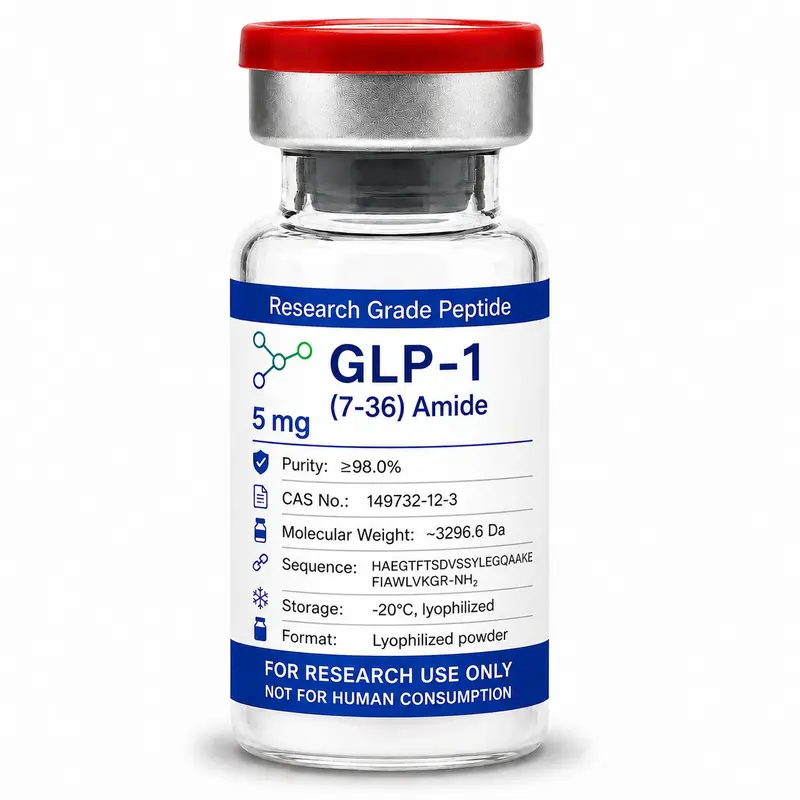
GLP-1 (7-36) Amide — The Native Reference Compound for Incretin Research
GLP-1 (7-36) Amide is the naturally occurring, biologically active form of glucagon-like peptide-1 — the incretin hormone that anchors an entire field of metabolic and receptor-pharmacology research. Where most peptides in a research catalog are synthetic analogs engineered to modify or extend a natural compound's behavior, GLP-1 (7-36) Amide is that natural compound: the exact amidated sequence the body itself produces and releases from intestinal L-cells in response to nutrient intake.
That distinction matters for researchers. Every synthetic GLP-1 receptor agonist on the market or in development — from early analogs through to Semaglutide and Tirzepatide — is ultimately evaluated against how closely, or how differently, it behaves relative to this native sequence. Northline supplies GLP-1 (7-36) Amide as a HPLC-verified, mass-spec-confirmed research reagent for laboratories that need that baseline compound on hand, shipped cold-chain to the USA and worldwide.
Structure, Sequence, and Why the Amide Form Matters
GLP-1 (7-36) Amide carries the sequence HAEGTFTSDVSSYLEGQAAKEFIAWLVKGR-NH2, with a molecular weight of approximately 3296.6 Da. The "7-36" numbering refers to its position within the larger proglucagon-derived precursor — this is the truncated, processed fragment that circulates and binds the GLP-1 receptor, distinct from earlier precursor forms like GLP-1 (1-37).
The terminal amidation (the "-NH2" at the sequence's end) is not a minor detail. It's the structural feature that distinguishes the active amidated form from the glycine-extended GLP-1 (7-37) variant, and it has real consequences for receptor affinity and in vitro stability. Researchers specifically requesting the amide form are usually doing so because their study design depends on matching the physiologically dominant circulating form, rather than a related but structurally distinct fragment.
Role in Metabolic and Receptor-Pharmacology Research
GLP-1 (7-36) Amide sits at the center of incretin-pathway research: studies examining glucose-dependent insulinotropic signaling, GLP-1 receptor binding kinetics, and downstream cyclic AMP signaling cascades all rely on having a reliable, correctly-sequenced native ligand to work from. Because native GLP-1 degrades rapidly via DPP-4 enzymatic cleavage — its circulating half-life in vivo is measured in minutes — it's particularly useful in short-timeframe in vitro binding assays and receptor-characterization studies where that native kinetic profile is exactly what's being measured.
It's also the standard comparator in structure-activity relationship (SAR) research on newer GLP-1 receptor agonists. When a lab is characterizing a novel analog, or comparing the receptor engagement profile of established analogs like Semaglutide or Tirzepatide, GLP-1 (7-36) Amide is frequently the reference point the comparison is built around — the compound that defines what "native" receptor activation actually looks like before any stabilizing modifications are introduced.
Because of this reference-compound role, demand for verified, correctly-sequenced GLP-1 (7-36) Amide spans academic metabolic-disease research, pharmaceutical structure-activity work, and comparative pharmacology studies across research institutions in the United States, Europe, and beyond.
GLP-1 (7-36) Amide vs. Synthetic GLP-1 Analogs
It's worth being precise about where GLP-1 (7-36) Amide fits relative to the synthetic analogs it's often compared against, since the distinction shapes which compound a given study actually needs:
Native GLP-1 (7-36) Amide is the unmodified endogenous sequence. Its defining research value is fidelity — it's what the receptor evolved to bind, which makes it the correct choice whenever a study's validity depends on native receptor kinetics rather than an extended-duration profile.
Liraglutide was among the first analogs to extend GLP-1's half-life, using a fatty-acid acylation strategy to promote albumin binding. It's a useful intermediate comparator between the native hormone and later-generation analogs.
Semaglutide pushed half-life extension further through additional structural modifications, making it a common reference point in current incretin pharmacokinetics research.
Tirzepatide departs from single-receptor GLP-1 agonism entirely, engaging both GLP-1 and GIP receptors — a meaningfully different mechanism that native GLP-1 (7-36) Amide is frequently used as a single-receptor control against in dual-agonism comparison studies.
Across all of these comparisons, the native sequence is the fixed point everything else is measured relative to — which is exactly why maintaining a verified, correctly-sequenced supply of it matters for any lab doing comparative incretin work.
Who Orders GLP-1 (7-36) Amide
Demand for a well-documented native GLP-1 reference compound spans several distinct research settings. Academic metabolic-disease and endocrinology labs use it in receptor-binding and signaling-pathway studies, often alongside cell lines expressing the GLP-1 receptor for in vitro pharmacology work. Biotech and pharmaceutical R&D groups developing next-generation incretin therapeutics use it as the structural and functional benchmark during early-stage analog design and structure-activity relationship (SAR) screening. Contract research organizations (CROs) running comparative pharmacology studies on behalf of sponsor companies need a dependable, re-orderable supply with consistent lot documentation — which is precisely the kind of institutional relationship our lab-account program is built around. And university core facilities supporting multiple research groups often keep GLP-1 (7-36) Amide on hand as shared reference stock for whichever project needs it next.
What all of these buyers have in common is that they're making comparative claims — and a comparison is only as strong as the reference compound underneath it. That's the specific gap Northline's verification process is built to close.
Formulation & Handling Notes for the Bench
GLP-1 (7-36) Amide ships as a lyophilized powder and should remain frozen at -20°C until you're ready to reconstitute it. Like most research peptides, it's commonly reconstituted in sterile water or a dilute acetic acid solution depending on your assay's buffer requirements — consult your lab's established protocol or the peptide's solubility profile for your specific application, since buffer choice affects downstream assay compatibility.
Once reconstituted, minimize freeze-thaw cycles: aliquotting into single-use volumes immediately after reconstitution is standard practice for preserving peptide integrity across a multi-week study rather than repeatedly thawing and refreezing a single stock vial. As with any peptide reagent, working solutions are generally less stable than the lyophilized form, so plan reconstitution timing around your actual assay schedule rather than reconstituting the full vial in advance.
A reference compound is only as useful as its documentation. If you can't confirm exactly what's in the vial, any comparison built on top of it is compromised from the start. That's why every GLP-1 (7-36) Amide lot Northline ships is independently verified by reverse-phase HPLC for purity — guaranteed at ≥98.0% — and confirmed by mass spectrometry to match the correct amidated sequence, not a related fragment or a degraded batch.
Each order ships with a certificate of analysis matched to the specific lot in your vial, not a generic specification sheet reused across production runs. That lot-level traceability is what lets you cite exactly what you tested with, and it's the same standard we apply across our full catalog of research peptides — BPC-157, TB-500, CJC-1295, Ipamorelin, Semaglutide, Tirzepatide, GHK-Cu, Epithalon, and Selank all ship under the same verification process.
Vials are packed and shipped cold-chain, with tracking sent to your inbox the moment your order leaves our facility. Every order is reviewed by a person on our team before fulfillment — nothing here runs on an automated checkout that skips a human check.
USA-Based, Worldwide Shipping for Research Institutions
Northline is a USA-based supplier, and we ship GLP-1 (7-36) Amide — along with our full research peptide catalog — to laboratories, universities, and research institutions both domestically and internationally. That includes established research markets across the European Union, United Kingdom, Canada, Australia, and the Asia-Pacific region.
International cold-chain shipping introduces real logistical variables — customs documentation, transit time, temperature control across longer routes — and we handle each of those directly rather than treating international orders as an afterthought. If your institution needs specific documentation to clear customs (a certificate of analysis, a research-use declaration, or invoice details formatted for your procurement process), our team can prepare that alongside your order.
For labs with recurring needs, we support standing orders and institutional billing arrangements — reach out through the contact page to set up a lab account rather than placing one-off orders each time your research schedule calls for more material.
Quality Assurance & Certificate of Analysis
Every production lot is sent to an independent lab for reverse-phase HPLC purity analysis and mass-spectrometry sequence confirmation before it's released for sale. We don't blend lots to smooth out a purity number, and we don't discount out-of-spec material instead of discarding it. If a lot doesn't clear ≥98.0% purity or doesn't match the correct amidated sequence, it doesn't ship. You're welcome to request a certificate of analysis before ordering if your institution requires documentation ahead of purchase for research or compliance review.
Frequently Asked Questions
What is GLP-1 (7-36) Amide used for in research?
It's used as the reference ligand for GLP-1 receptor binding studies, incretin-pathway pharmacology, and comparative research against synthetic long-acting GLP-1 analogs.
How is it different from Semaglutide or Tirzepatide?
GLP-1 (7-36) Amide is the native, short-half-life hormone sequence. Semaglutide and Tirzepatide are engineered analogs built to resist rapid breakdown. Researchers often use the native form as the baseline when characterizing how those modified analogs behave differently at the receptor.
What purity level do you guarantee?
≥98.0%, independently verified by HPLC with mass-spec sequence confirmation, and a certificate of analysis matched to your specific lot included with every order.
Do you ship internationally?
Yes — to the USA and worldwide, including the EU, UK, Canada, Australia, and Asia-Pacific, with cold-chain packaging on every order.
How should it be stored?
-20°C while lyophilized. Follow standard cold-chain handling once reconstituted for laboratory use.
Can I order in bulk for a lab or institution?
Yes — contact our team to set up a lab account for standing or bulk orders with institutional billing.