Every SKU below ships with a lot-matched certificate of analysis. Pricing is per vial. Adding to cart or ordering routes to our team for confirmation — no payment is collected on this site.
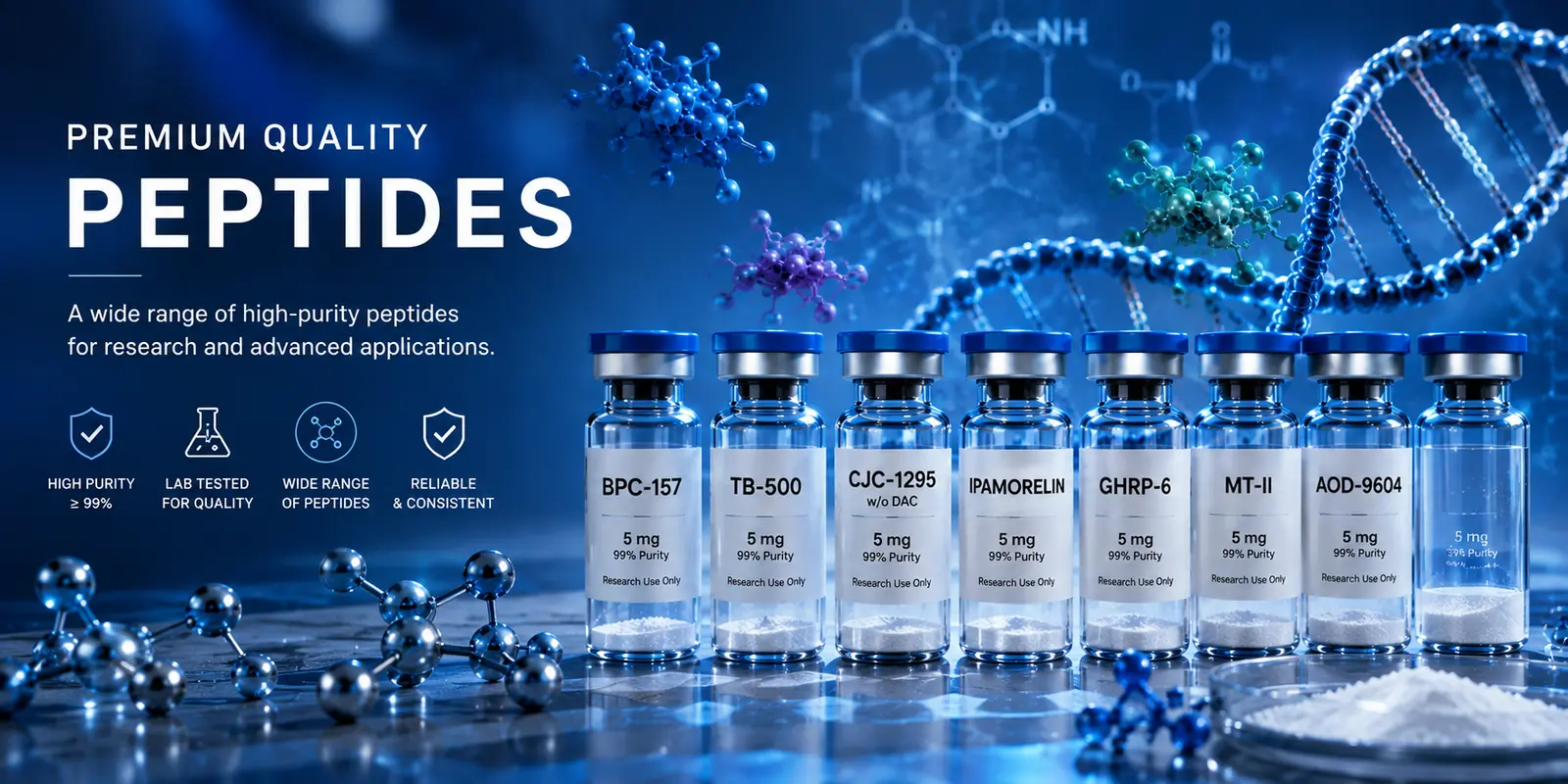
Research peptides are short chains of amino acids synthesized as laboratory reagents rather than consumer products — used to study receptor pharmacology, cell signaling, tissue-repair mechanisms, and metabolic pathways. Every compound in our catalog is manufactured and documented for laboratory research use only, never for human or veterinary consumption.
Receptor-binding assays, cell-migration and angiogenesis studies, comparative pharmacology, and structure-activity relationship (SAR) research across academic, biotech, and contract research settings.
Most lyophilized peptides are stored at -20°C; a few, like GHK-Cu, are refrigerated at 2-8°C. Cold-chain shipping and minimal freeze-thaw cycling after reconstitution preserve integrity for the length of a study.
Every lot is independently verified by reverse-phase HPLC for purity and mass spectrometry for sequence identity, with a certificate of analysis matched to that specific production run — not a generic spec sheet.
A lot-specific certificate of analysis, cold-chain packaging, and tracking from dispatch to delivery. Documentation is also available on request before you order, for institutional compliance review.
Native GLP-1, Semaglutide, and Tirzepatide — incretin-pathway compounds for metabolic receptor research.
Shop this category →
Ipamorelin and CJC-1295 — ghrelin-receptor and GHRH-pathway compounds for pulsatile hormone-release research.
Shop this category →
BPC-157, TB-500, and GHK-Cu — tissue-repair and extracellular-matrix remodeling research compounds.
Shop this category →
GLP-1 family compounds studied in glucose-homeostasis and metabolic signaling pathway research.
Shop this category →
What are research peptides?
Research peptides are short chains of amino acids synthesized for use as laboratory reagents, not for human or veterinary consumption. They're used to study receptor pharmacology, cell signaling, tissue-repair mechanisms, and metabolic pathways across academic and biotech research settings.
Are research peptides the same as pharmaceutical drugs?
No. Research peptides are manufactured and documented for laboratory research use, verified by HPLC and mass spectrometry, but they have not gone through the clinical trials, FDA approval, or GMP pharmaceutical manufacturing certification required for human or veterinary drug products.
Is it legal to buy research peptides in the USA?
Yes, research peptides are legal to purchase and sell in the USA when marketed and sold strictly for laboratory research use by qualified professionals, and not represented or sold for human consumption, diagnostic, or therapeutic purposes.
What purity level should I expect from a research peptide?
Reputable suppliers verify research peptides at 98% purity or higher, confirmed independently by reverse-phase HPLC, with mass-spectrometry sequence confirmation included in the certificate of analysis.
What is a certificate of analysis (COA)?
A COA is a lab document confirming a specific production lot's purity (via HPLC) and identity (via mass spectrometry). It should be matched to the exact lot you receive, not a generic specification sheet reused across every batch.
How should research peptides be stored?
Most lyophilized research peptides should be stored at -20°C. A few compounds, such as copper peptides like GHK-Cu, are stored refrigerated at 2-8°C instead. Always follow the storage guidance on the specific compound's certificate of analysis.
Do you ship research peptides internationally?
Yes, Northline ships to research institutions across the United States and internationally, including the EU, UK, Canada, Australia, and the Asia-Pacific region, using cold-chain packaging on every order.
Can I order research peptides wholesale or in bulk?
Yes, we support wholesale and lab-account arrangements for institutions, universities, and research groups with recurring or bulk ordering needs. Contact our team to set up an account.
What research peptide categories does Northline carry?
Our catalog spans GLP-1 and metabolic research peptides (native GLP-1, Semaglutide, Tirzepatide), growth-hormone pathway peptides (Ipamorelin, CJC-1295), healing and recovery peptides (BPC-157, TB-500, GHK-Cu), and additional specialty research compounds (Epithalon, Selank).
How is purity verified for every order?
Every production lot is independently tested by reverse-phase HPLC for purity and mass spectrometry for sequence identity before it's released for sale. Lots that don't clear our purity threshold are not shipped.
What does 'research use only' actually mean on the label?
It means the compound is intended solely for laboratory research applications by qualified professionals, and is explicitly not intended for human or veterinary consumption, diagnostic use, or therapeutic administration.
How quickly are orders shipped once placed?
Orders are reviewed by our team and typically shipped cold-chain within one to two business days of confirmation, with tracking sent to your email once the order is dispatched.
Can I request a certificate of analysis before I order?
Yes, we're happy to provide lot-specific COA documentation ahead of purchase if your institution requires it for compliance or procurement review — just reach out through the contact page.
What's the difference between the compound categories on this page?
GLP-1 Research Peptides and Metabolic Research Peptides cover incretin-pathway compounds (native GLP-1, Semaglutide, Tirzepatide). Growth Hormone Peptides cover pulsatile hormone-release research compounds (Ipamorelin, CJC-1295). Healing & Recovery Peptides cover tissue-repair and regenerative research compounds (BPC-157, TB-500, GHK-Cu).
Do you support institutional billing for universities and labs?
Yes, we support institutional billing arrangements through our lab account program for universities, research institutions, and contract research organizations with standing or recurring orders.
Background, mechanisms, and sourcing notes for every peptide in the catalog — written for researchers, not marketing copy.
Tell us what you're studying and we'll point you to the right compound, concentration, and format.