
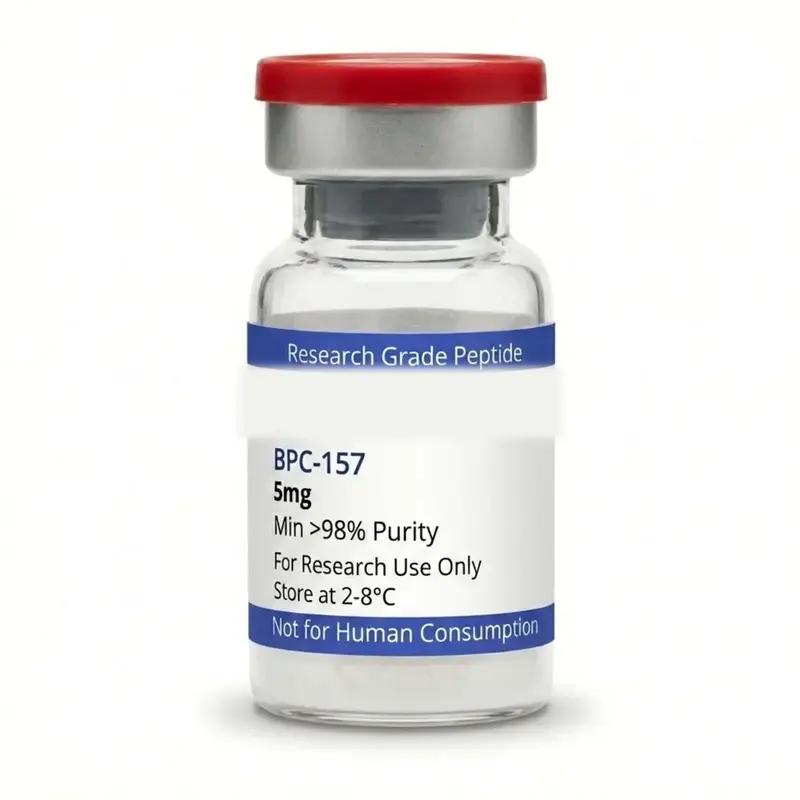
BPC-157 — Research-Grade Pentadecapeptide
BPC-157 is a synthetic 15-amino-acid peptide fragment derived from a protective protein found in human gastric juice. It is one of the most widely studied compounds in tissue-repair and gut-barrier research literature, referenced across in vitro and animal-model studies examining cellular migration, angiogenesis, and recovery pathways.
Researchers studying tissue-repair mechanisms, wound-healing pathways, and gastrointestinal protection models frequently source BPC-157 for its stability compared to other gastric peptide fragments — it remains active across a wide pH range in laboratory conditions, which is part of why it appears so often in comparative peptide-stability literature.
Structure and Stability
BPC-157's 15-residue sequence is short enough to synthesize consistently while retaining the structural features believed responsible for its activity in tissue-repair models. Its resistance to degradation across varying pH conditions — a property most peptide fragments don't share — is frequently cited as the reason it remains active long enough in vitro to be useful in extended assay designs, rather than degrading before an experiment can capture meaningful data.
Research Applications
BPC-157 appears throughout published in vitro and animal-model literature examining cellular migration, angiogenesis (new blood vessel formation), and gut-barrier integrity. It's a frequent reference compound in wound-healing and tissue-repair pathway research, often used alongside other regenerative peptides in comparative study designs examining which mechanisms drive repair outcomes fastest or most completely.
Because of its gastric origin, BPC-157 also shows up specifically in gastrointestinal protection research — studies examining barrier integrity, mucosal repair, and recovery from induced injury models in cell culture and animal studies.
BPC-157 vs. TB-500: Two Different Repair Mechanisms
BPC-157 and TB-500 are frequently discussed together since both are studied in tissue-repair contexts, but they work through distinct mechanisms. BPC-157 is believed to act on angiogenesis and gut-barrier pathways specific to its gastric-derived sequence, while TB-500 (a Thymosin Beta-4 fragment) acts on actin regulation and cell-migration machinery. Researchers studying combined or comparative repair mechanisms often work with both compounds side by side precisely because their pathways don't fully overlap.
Purity Verification for BPC-157
BPC-157's stability across pH ranges is a research advantage, but it also means visual inspection alone can't tell you whether a vial actually contains correctly-synthesized, full-purity material — degraded or incompletely synthesized fragments can look identical to the intact peptide. That's why independent HPLC purity data paired with mass-spec sequence confirmation matters specifically for this compound: without it, you're trusting a label rather than verified data.
Molecular Profile
BPC-157 carries CAS number 137525-51-0, with a 15-residue sequence (Gly-Glu-Pro-Pro-Pro-Gly-Lys-Pro-Ala-Asp-Asp-Ala-Gly-Leu-Val) derived from its parent gastric protective protein. Its relatively short length compared to larger research peptides makes full sequence confirmation by mass spectrometry both fast and inexpensive for a supplier to provide — a low bar that any legitimate BPC-157 source should clear.
Who Orders BPC-157
Demand spans academic tissue-repair and gastroenterology research labs, biotech groups studying regenerative pathways, and contract research organizations running comparative wound-healing studies on behalf of sponsor companies. University core facilities supporting multiple research groups also keep BPC-157 on hand as shared reference stock given how frequently it appears across different research programs.
Why Researchers Choose Northline's BPC-157
Every BPC-157 lot sold by Northline Peptides is independently verified by reverse-phase HPLC and mass spectrometry before release, with a certificate of analysis (COA) matched to the specific lot shipped — not a generic specification sheet reused across every batch. That lot-level traceability lets you cite exactly what you tested with.
USA-Based, Worldwide Shipping
We supply research institutions, universities, and laboratories across the United States and internationally, with cold-chain packaging on every order and tracking sent the moment your order leaves our facility. For labs with recurring needs, we support standing orders and institutional billing — reach out through the contact page to set up a lab account.
Storage & Handling Notes
Store lyophilized BPC-157 at -20°C until ready for reconstitution. Once reconstituted, minimize freeze-thaw cycles by aliquotting into single-use volumes, and plan reconstitution timing around your actual assay schedule rather than preparing the full vial in advance.
Frequently Referenced Alongside
BPC-157 appears often in the same study designs as TB-500 and GHK-Cu, since all three sit within the broader tissue-repair and regenerative-research category, even though each acts through a distinct mechanism. Labs running comparative repair-pathway research frequently keep more than one of the three on hand to isolate which mechanism drives a given outcome.
Frequently Asked Questions
What is BPC-157 used for in research?
BPC-157 is studied in tissue-repair, gut-barrier integrity, and angiogenesis research, referenced across in vitro and animal-model studies examining cellular migration and recovery pathways.
How is BPC-157 different from TB-500?
BPC-157 is believed to act on gut-barrier and angiogenesis pathways tied to its gastric-derived sequence, while TB-500 acts on actin regulation and cell-migration machinery derived from Thymosin Beta-4. They're often studied together for their distinct, complementary mechanisms.
What purity does Northline guarantee for BPC-157?
Every lot is independently verified at ≥99% purity by reverse-phase HPLC, with mass-spectrometry sequence confirmation and a certificate of analysis matched to your specific lot.
Do you ship BPC-157 internationally?
Yes, we ship to research institutions across the USA and internationally with cold-chain packaging on every order.
How should BPC-157 be stored?
Store lyophilized BPC-157 at -20°C. Once reconstituted, minimize freeze-thaw cycles and use within the timeframe appropriate for your buffer system.
How does BPC-157's stability across pH levels help research?
Its resistance to degradation across a wide pH range means it stays active long enough in vitro to be useful across extended assay designs, rather than degrading before an experiment can capture meaningful data.