CJC-1295 (No DAC) — GHRH Analog Research Peptide
CJC-1295 (no DAC) is a modified fragment of growth-hormone-releasing hormone (GHRH), spanning the first 29 amino acids of the native sequence with stabilizing substitutions. Unlike the DAC-conjugated version, this no-DAC form has a shorter research half-life, making it useful in studies requiring more precise temporal control over receptor activation.
It's frequently used in stacked-protocol research alongside ghrelin-receptor agonists like Ipamorelin, allowing researchers to study combined-pathway effects on pulsatile hormone release.
The DAC vs. No-DAC Distinction
"DAC" refers to Drug Affinity Complex, a chemical modification that binds the peptide to albumin in the bloodstream, extending its active duration substantially. The no-DAC version skips that modification, giving it a much shorter research half-life — precisely why some study designs specifically call for it: researchers wanting tight temporal control over GHRH-receptor activation need a compound that clears predictably, not one designed to linger.
Research Applications
CJC-1295 (no DAC) is used in studies examining GHRH-receptor activation kinetics, and as one half of combined-pathway research protocols pairing GHRH-receptor and ghrelin-receptor agonists to study pulsatile hormone-release patterns under dual activation.
CJC-1295 vs. Ipamorelin: Complementary Mechanisms
Since CJC-1295 (no DAC) acts on the GHRH receptor — a different pathway than ghrelin-receptor agonists like Ipamorelin — the two are frequently studied together to characterize whether combined-pathway activation produces different pulsatile release patterns than either mechanism alone. This is one of the more common combined-protocol designs in growth-hormone pathway research.
Purity Verification for CJC-1295
Beyond standard purity and sequence verification, confirming which version of CJC-1295 you're receiving — DAC or no-DAC — is its own critical documentation point, since the two behave very differently in a research context despite sharing a name. A proper COA should make this explicit, not leave it to be inferred from the label alone.
Molecular Profile
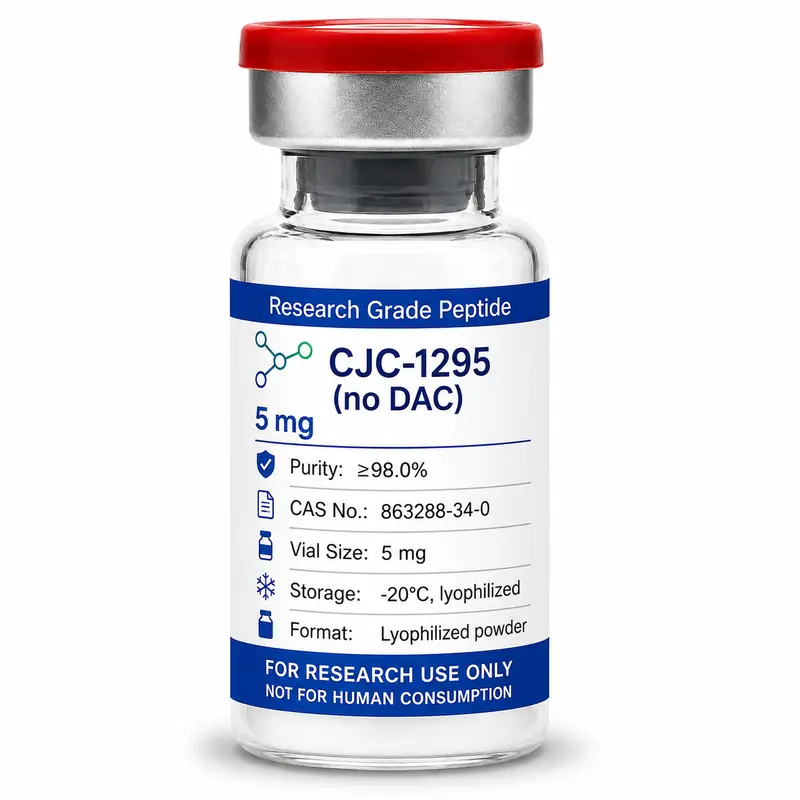
CJC-1295 (no DAC) carries CAS number 863288-34-0, covering a modified 29-amino-acid fragment of growth-hormone-releasing hormone (GHRH). Its stabilizing substitutions relative to native GHRH improve resistance to enzymatic breakdown while preserving the receptor-relevant structure researchers are studying.
Who Orders CJC-1295
Demand comes from academic endocrinology labs, biotech groups studying GHRH-receptor pharmacology, and contract research organizations running comparative pulsatile-hormone-release studies — often ordering CJC-1295 alongside Ipamorelin for combined-protocol designs.
Why Researchers Choose Northline's CJC-1295
Each CJC-1295 (no DAC) lot is independently verified by HPLC and mass spectrometry, with a matched certificate of analysis. We're explicit about supplying the no-DAC form specifically — confirm which version you need, since DAC and no-DAC behave very differently in a research context.
USA-Based, Worldwide Shipping
Northline Peptides ships cold-chain to laboratories throughout the USA and internationally. Contact our team about lab accounts for recurring orders, particularly for labs running combined CJC-1295/Ipamorelin protocols.
Storage & Handling Notes
Store lyophilized CJC-1295 at -20°C. Once reconstituted, minimize freeze-thaw cycles by aliquotting into single-use volumes.
Frequently Referenced Alongside
CJC-1295 (no DAC) is most commonly ordered alongside Ipamorelin for combined-protocol pulsatile hormone-release research, given their complementary GHRH-receptor and ghrelin-receptor mechanisms.
Frequently Asked Questions
What is CJC-1295 (no DAC) used for in research?
CJC-1295 (no DAC) is studied as a GHRH-receptor analog in pulsatile growth-hormone release research, often paired with ghrelin-receptor agonists like Ipamorelin.
What's the difference between CJC-1295 with and without DAC?
The DAC modification extends the compound's active duration by binding it to albumin in the bloodstream. The no-DAC version skips this, giving it a much shorter, more precisely controllable research half-life.
What purity does Northline guarantee for CJC-1295?
Every lot is independently verified at ≥98% purity by reverse-phase HPLC, with mass-spectrometry sequence confirmation.
Do you ship CJC-1295 internationally?
Yes, we ship to research institutions across the USA and internationally with cold-chain packaging on every order.
How should CJC-1295 be stored?
Store lyophilized CJC-1295 at -20°C. Minimize freeze-thaw cycles once reconstituted.
Can I order CJC-1295 and Ipamorelin together?
Yes, the two are frequently ordered together for combined-protocol research — contact our team about lab accounts for recurring multi-compound orders.