
CJC-1295 (No DAC) vs. DAC Versions: Why the Distinction Matters
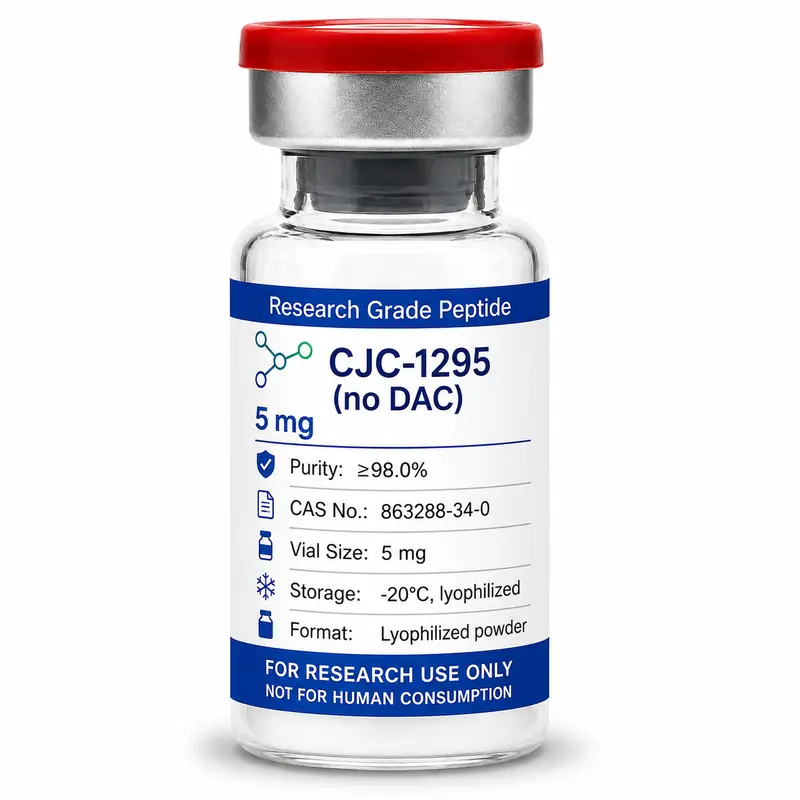
What CJC-1295 actually is
CJC-1295 is a modified fragment covering the first 29 amino acids of growth-hormone-releasing hormone (GHRH), with stabilizing substitutions that improve its resistance to enzymatic breakdown compared to native GHRH fragments.
The DAC distinction
"DAC" refers to Drug Affinity Complex, a chemical modification that binds the peptide to albumin in the bloodstream, extending its active duration substantially. The no-DAC version skips that modification, giving it a much shorter research half-life — which is precisely why some study designs specifically call for it: researchers wanting tight temporal control over GHRH-receptor activation need a compound that clears predictably, not one designed to linger.
Why it's often paired with ghrelin-receptor agonists
Since CJC-1295 (no DAC) acts on the GHRH receptor — a different pathway than ghrelin-receptor agonists like Ipamorelin — the two are frequently studied together to characterize whether combined-pathway activation produces different pulsatile release patterns than either mechanism alone.
Sourcing notes
Confirm explicitly whether you're being sold the DAC or no-DAC version — the two behave very differently in a research context, and mislabeling (accidental or otherwise) is a real risk in this market.
Further reading
- Search current CJC-1295 (no DAC) literature on PubMed — peer-reviewed studies indexed by the National Library of Medicine.
- View the CJC-1295 (no DAC) compound record on PubChem — chemical structure and reference data from NCBI.
- Look up CAS 863288-34-0 on CAS Common Chemistry — registry verification from the American Chemical Society.