Epithalon — Synthetic AEDG Tetrapeptide Research Peptide
Epithalon (also written Epitalon) is a synthetic tetrapeptide with the amino-acid sequence Ala-Glu-Asp-Gly (AEDG), developed as a synthetic analog of a naturally occurring pineal-gland peptide. It has become a frequently cited compound in cellular-senescence and telomerase-activity research literature.
Laboratory studies examining chromosomal aging markers and telomerase-activation pathways commonly reference Epithalon as a model compound, particularly in comparative in vitro cell-culture studies looking at proliferation limits and senescence markers.
Why a Four-Amino-Acid Sequence Has Outsized Research Value
Epithalon is about as simple as research peptides get structurally, which is part of its research appeal — a short, well-characterized sequence is easy to synthesize consistently and verify by mass spectrometry, reducing a variable that more complex peptides introduce. Its simplicity hasn't limited its research footprint; it remains a standard reference compound in senescence-pathway literature specifically because that simplicity makes comparative studies easier to design and interpret.
Research Applications
Most published research involving Epithalon centers on comparative in vitro work — looking at senescence markers and proliferative capacity in cell lines exposed to the compound versus controls. As with most research peptides, results are model-dependent, and readers should be cautious about extrapolating cell-culture findings beyond the specific system studied.
Epithalon Among Specialty Research Compounds
Epithalon and Selank both occupy a specialty niche in Northline's catalog distinct from the tissue-repair, metabolic, and growth-hormone categories — each tied to a specific, narrower research literature (cellular senescence for Epithalon, anxiolytic/cognitive research for Selank) rather than a broad pathway shared with several other catalog compounds.
Purity Verification for Epithalon
Epithalon's short four-residue sequence makes complete mass-spec verification fast and low-cost for any legitimate supplier to provide — a COA showing purity without sequence confirmation is a harder gap to justify here than for almost any other compound, given how little it would cost to close it.
Molecular Profile
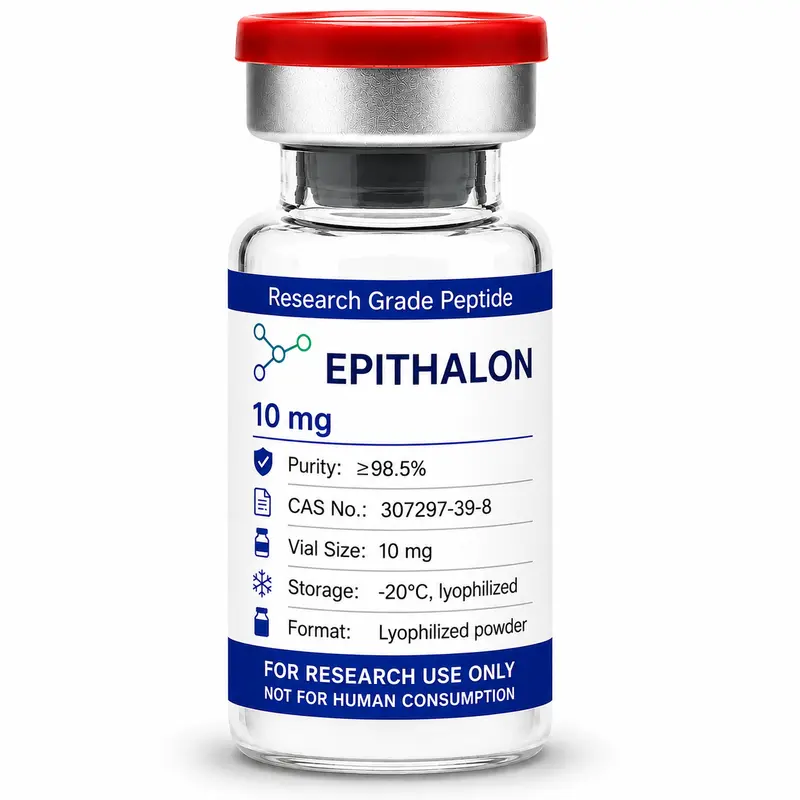
Epithalon carries CAS number 307297-39-8, with the sequence Ala-Glu-Asp-Gly (AEDG) forming a synthetic analog of a naturally occurring pineal-gland peptide. Its structural simplicity is precisely what makes it a practical, consistently reproducible reference compound across comparative senescence-research study designs.
Who Orders Epithalon
Demand comes from academic aging-biology and cellular-senescence research labs, biotech groups studying telomerase-activation pathways, and contract research organizations running comparative in vitro cell-culture studies.
Why Researchers Choose Northline's Epithalon
Every Epithalon lot sold by Northline Peptides is independently verified by HPLC and mass spectrometry, with a certificate of analysis matched to the shipped lot. Because Epithalon's sequence is so short, mass-spec verification is quick and inexpensive for a supplier to provide — there's little justification for a COA that shows purity without sequence confirmation.
USA-Based, Worldwide Shipping
We ship cold-chain to research institutions across the USA and internationally. Contact our team about lab accounts for recurring Epithalon orders.
Storage & Handling Notes
Store lyophilized Epithalon at -20°C. Once reconstituted, minimize freeze-thaw cycles by aliquotting into single-use volumes.
Frequently Referenced Alongside
Epithalon is sometimes ordered alongside Selank as part of a broader specialty-compound research program, though the two are studied for entirely different purposes — cellular senescence versus anxiolytic/cognitive research — and aren't mechanistically related.
Frequently Asked Questions
What is Epithalon used for in research?
Epithalon is studied in cellular-senescence and telomerase-activity research, commonly referenced in comparative in vitro cell-culture studies examining chromosomal aging markers.
What does the AEDG sequence mean?
AEDG refers to Epithalon's four-amino-acid sequence (Ala-Glu-Asp-Gly), a synthetic analog of a naturally occurring pineal-gland peptide.
What purity does Northline guarantee for Epithalon?
Every lot is independently verified at ≥98.5% purity by reverse-phase HPLC, with mass-spectrometry sequence confirmation.
Do you ship Epithalon internationally?
Yes, we ship to research institutions across the USA and internationally with cold-chain packaging on every order.
How should Epithalon be stored?
Store lyophilized Epithalon at -20°C. Minimize freeze-thaw cycles once reconstituted.
Is Epithalon the same as Epitalon?
Yes, both spellings refer to the same synthetic AEDG tetrapeptide sequence; 'Epitalon' is a commonly used alternate spelling in research literature.