Research Peptides: What They Are and How to Source Them in the USA
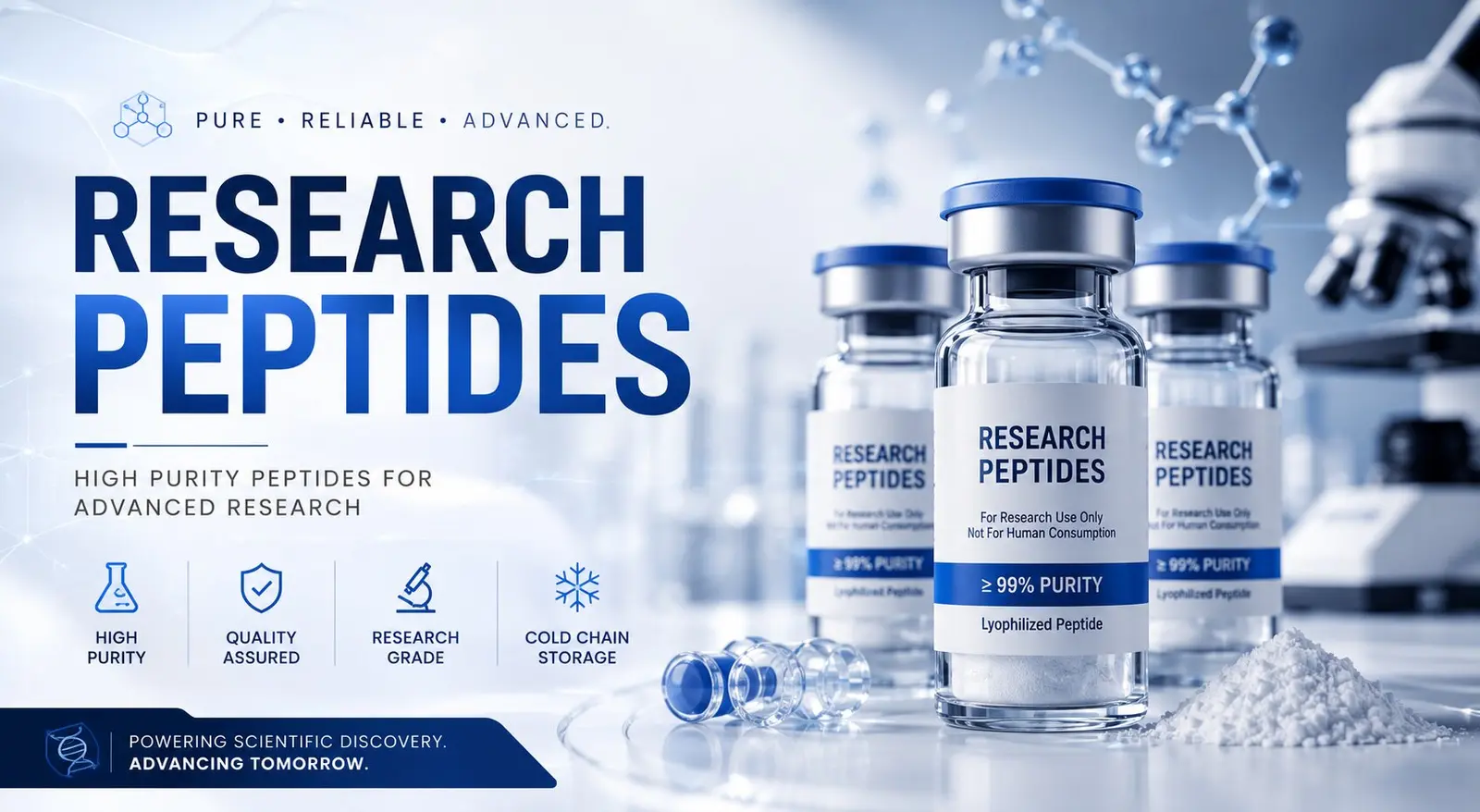
What Are Research Peptides?
Research peptides are short chains of amino acids — typically anywhere from a handful to a few dozen residues — synthesized for use as laboratory reagents rather than as consumer products. They're used across academic, biotech, and pharmaceutical research settings to study receptor pharmacology, cell signaling, tissue-repair mechanisms, and metabolic pathways, among many other areas. Some research peptides are exact synthetic replicas of naturally occurring compounds (native hormone sequences, for example); others are engineered analogs designed to modify how a natural compound behaves — extending its stability, changing its receptor selectivity, or isolating a specific structural feature for study.
The common thread across the category is that research peptides are sold and labeled explicitly for laboratory research use, not for human or veterinary consumption, diagnostic use, or therapeutic administration. That distinction isn't just a legal formality — it reflects the actual manufacturing and quality-control pathway these compounds go through, which is built around research-grade specification rather than pharmaceutical-grade drug manufacturing and clinical approval.
Why Purity and Documentation Matter
In a research setting, a peptide's value is entirely tied to how confident you can be about what's actually in the vial. A compound that's only 85% pure, or that contains a related-but-different sequence variant, can quietly compromise months of comparative work without anyone realizing it until results stop replicating. That's why purity verification isn't a nice-to-have for research grade peptides — it's the foundation the rest of the research depends on.
Two independent methods are standard for verifying research peptide quality: reverse-phase HPLC (high-performance liquid chromatography), which measures purity as a percentage, and mass spectrometry, which confirms that the synthesized sequence actually matches the intended compound rather than a related fragment or degraded byproduct. A real certificate of analysis (COA) reports both — not just a purity number, but confirmation of identity — and it should be matched to the specific production lot you're receiving, not a generic specification sheet reused across every batch a supplier has ever shipped.
Sourcing Research Peptides in the USA: What to Look For
The research peptide supply market in the USA varies enormously in quality and transparency. A few concrete things are worth checking before you commit to a research peptide supplier: Does every lot ship with its own matched COA, or a generic one? Will the supplier provide documentation before purchase if your institution requires it for compliance review? Is the sequence and purity independently verified by a third-party lab, or is the purity number simply asserted on the label? Is the peptide shipped cold-chain, with packaging appropriate for a compound that degrades at room temperature?
It's also worth paying attention to how a supplier talks about its products. Research peptide products described with human dosing guidance, health-outcome claims, or consumer-style marketing language are a signal worth taking seriously — legitimate research-grade suppliers keep their labeling and marketing squarely inside research use, because that's the category the compounds are actually manufactured and documented for.
Research Peptide Wholesale & Bulk Ordering
Beyond individual vial orders, many labs, universities, and contract research organizations need a standing supply relationship — recurring orders, institutional billing, and consistent lot-to-lot quality across a research program that might run for months or years. This is where working with a research peptide wholesale USA distributor rather than placing one-off retail orders becomes practical: bulk pricing, dedicated account support, and predictable turnaround matter more than per-vial cost when you're managing a research budget and timeline.
A wholesale research peptides USA relationship should still come with the same documentation standard as a single-vial order — bulk quantity doesn't justify looser quality control, and if anything, a larger order riding on unverified material represents more risk to a research program, not less.
Common Applications of Research Peptides Across the Lab
Different peptide categories map to different research applications. Tissue-repair and regenerative peptides (such as BPC-157, TB-500, and GHK-Cu) are used in cell-migration assays, angiogenesis studies, and extracellular-matrix remodeling research. Metabolic and incretin peptides (native GLP-1, Semaglutide, Tirzepatide) support receptor-binding and signaling-pathway studies tied to glucose homeostasis research. Growth-hormone pathway peptides (Ipamorelin, CJC-1295) are used in pulsatile hormone-release research, often in stacked-protocol study designs examining combined receptor activation. Understanding which category a given research question falls into is usually the fastest way to narrow down which compound, or combination of compounds, a study actually needs.
How to Read a Certificate of Analysis
A proper COA should show, at minimum: the specific lot number matching your shipment, the HPLC purity result as a percentage, the method used (typically reverse-phase HPLC), mass-spectrometry confirmation of molecular weight or sequence identity, the test date, and appearance/solubility notes. If a supplier can't produce a COA showing lot-specific results — rather than a generic specification document reused across every batch — that's a meaningful gap in documentation, regardless of how confident the marketing copy sounds.
Common Research Peptide Applications by Region
Demand for verified research peptides spans research institutions nationwide — from university biomedical research departments to independent contract research organizations and biotech R&D groups. A research peptide supplier USA with domestic operations typically offers faster turnaround and more straightforward compliance documentation for USA-based institutions than an overseas supplier, though cold-chain logistics and customs handling matter more once shipping internationally to institutions outside the country.
Northline as a Research Peptide Supplier
Northline Peptide Co. operates as a USA-based research peptide manufacturer and distributor, supplying laboratories, universities, and biotech research groups with HPLC-verified, mass-spec-confirmed compounds — each shipped with a certificate of analysis matched to its specific production lot. Our current catalog spans tissue-repair peptides (BPC-157, TB-500, GHK-Cu), incretin and metabolic research compounds (Semaglutide, Tirzepatide, native GLP-1), growth-hormone pathway peptides (Ipamorelin, CJC-1295), and additional research compounds including Epithalon and Selank. We ship cold-chain to research institutions across the United States and internationally, and support standing lab accounts for research groups with recurring or bulk ordering needs.
Frequently Asked Questions
What is the difference between research peptides and pharmaceutical peptides?
Research peptides are manufactured and documented for laboratory research use, verified by HPLC and mass spectrometry, but they have not gone through pharmaceutical drug manufacturing standards or clinical approval processes required for human or veterinary use.
Are research peptides legal to purchase in the USA?
Research peptides are legal to purchase and sell in the USA when marketed and used strictly for laboratory research purposes by qualified professionals, and not represented or sold for human consumption, diagnostic, or therapeutic use.
What does 'research grade' actually mean?
Research grade means a compound has been synthesized and verified to a documented purity and identity standard suitable for laboratory research applications, typically confirmed by third-party HPLC purity testing and mass-spectrometry sequence verification.
How do I know if a research peptide supplier is reputable?
Look for lot-specific certificates of analysis, independent third-party purity verification, clear research-use-only labeling without human dosing claims, and transparent communication about sourcing and testing methodology.
Can I buy research peptides wholesale in the USA?
Yes. Many research peptide suppliers, including Northline, offer wholesale and lab-account arrangements for institutions and research groups with recurring or bulk ordering needs, typically with institutional billing support.
Do research peptides need to be stored refrigerated or frozen?
Most lyophilized research peptides are stored at -20°C, though a few compounds (such as copper peptides) are stored refrigerated at 2-8°C. Always follow the specific storage guidance on the certificate of analysis for each compound.
What is a certificate of analysis (COA) and why does it matter?
A COA is a lab document confirming a specific production lot's purity (via HPLC) and identity (via mass spectrometry). It matters because it's the only way to verify what's actually in the vial rather than relying on the label alone.