
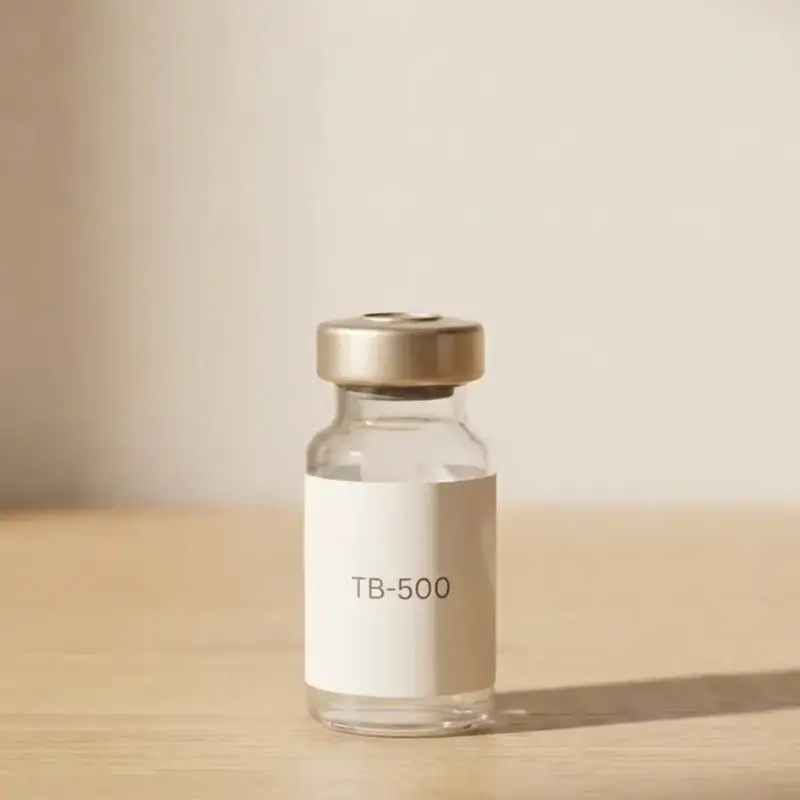
TB-500 — Thymosin Beta-4 Fragment Research Peptide
TB-500 is a short synthetic peptide fragment derived from the naturally occurring protein Thymosin Beta-4, a regulator of the actin cytoskeleton involved in cell migration. It's a mainstay in cell-motility and tissue-remodeling research, particularly in studies examining how cells reorganize their internal scaffolding during repair processes.
Because Thymosin Beta-4 plays a role in actin sequestration, TB-500 is frequently used in laboratory models studying angiogenesis, cell migration assays, and comparative fragment-activity studies against the full-length parent protein.
Why Researchers Use the Fragment, Not the Whole Protein
Working with a full-length protein in a lab setting is often less practical than working with a short, stable, well-characterized fragment. TB-500 preserves the region of Thymosin Beta-4 believed to be most active in actin-sequestering behavior, while being small enough to synthesize consistently and handle predictably across experiments — a meaningful advantage when a study requires reproducible dosing across many replicate runs.
Research Applications
TB-500 is a recurring reference compound in angiogenesis studies, cell-motility assays, and comparative research examining how synthetic fragments perform relative to native full-length Thymosin Beta-4. Because of its role in cytoskeletal regulation, it also appears in broader tissue-remodeling literature.
Its small size makes it relatively straightforward to verify by mass spectrometry, which is part of why it's a popular choice for labs that need high confidence in sequence identity alongside purity data.
TB-500 vs. BPC-157: Complementary Repair Pathways
TB-500 and BPC-157 are frequently studied together, but through different mechanisms — TB-500 acts on the actin cytoskeleton and cell-migration machinery, while BPC-157 is believed to act on angiogenesis and gut-barrier pathways specific to its own sequence. Comparative or combined-protocol study designs often include both precisely because they intervene at different points in the repair process.
Purity Verification for TB-500
TB-500's short length relative to the full Thymosin Beta-4 protein makes it comparatively fast and inexpensive to verify by mass spectrometry, which is part of why a COA lacking sequence confirmation — showing only an HPLC purity percentage — is a meaningful red flag rather than an acceptable shortcut for this specific compound.
Molecular Profile
TB-500 carries CAS number 77591-33-4. As a fragment rather than the full 43-amino-acid Thymosin Beta-4 protein, it isolates the region believed most responsible for actin-sequestering activity, giving researchers a more tractable, consistently synthesizable tool than working with the complete native protein would allow.
Who Orders TB-500
Demand comes from academic cell-biology and regenerative-medicine labs, biotech groups studying wound-healing mechanisms, and contract research organizations running comparative tissue-repair studies. Labs studying cytoskeletal dynamics more broadly also request TB-500 as a well-characterized reference fragment.
Why Researchers Choose Northline's TB-500
Each TB-500 vial ships with a lot-specific certificate of analysis backed by independent HPLC purity testing and mass-spec sequence confirmation — not a generic specification sheet. That documentation standard applies whether you're ordering one vial or setting up a recurring lab account.
USA-Based, Worldwide Shipping
Northline Peptides ships cold-chain to research labs across the USA and internationally, with documentation available on request before you order. We support standing lab accounts for institutions with recurring TB-500 ordering needs.
Storage & Handling Notes
Store lyophilized TB-500 at -20°C. Once reconstituted, aliquot into single-use volumes to minimize freeze-thaw cycling, which is one of the more common avoidable sources of peptide degradation in a research setting.
Frequently Referenced Alongside
TB-500 is often ordered alongside BPC-157 and GHK-Cu for comparative tissue-repair research, and alongside other cytoskeletal-regulation compounds when a study is specifically isolating actin-pathway effects from other repair mechanisms.
Frequently Asked Questions
What is TB-500 used for in research?
TB-500 is studied in cell-migration, angiogenesis, and tissue-remodeling research as a synthetic fragment of Thymosin Beta-4, a natural regulator of the actin cytoskeleton.
How is TB-500 different from BPC-157?
TB-500 acts on actin regulation and cell-migration machinery, while BPC-157 acts on gut-barrier and angiogenesis pathways tied to its own distinct sequence. They're often studied together for their complementary mechanisms.
What purity does Northline guarantee for TB-500?
Every lot is independently verified at ≥98.5% purity by reverse-phase HPLC, with mass-spectrometry sequence confirmation and a certificate of analysis matched to your specific lot.
Do you ship TB-500 internationally?
Yes, we ship to research institutions across the USA and internationally with cold-chain packaging on every order.
How should TB-500 be stored?
Store lyophilized TB-500 at -20°C. Once reconstituted, minimize freeze-thaw cycles and aliquot into single-use volumes.
Is TB-500 the same as the full Thymosin Beta-4 protein?
No, TB-500 is a fragment isolating the region of Thymosin Beta-4 believed most responsible for actin-sequestering activity, not the complete 43-amino-acid native protein.