
Ipamorelin: Why Receptor Selectivity Is the Whole Story
The problem with earlier secretagogues
Older growth-hormone secretagogues often activated multiple receptor pathways at once, which made isolating their specific effects on growth-hormone pulsatility difficult — other receptor activity muddied the research picture. Ipamorelin was developed specifically to address that.
What selective means here
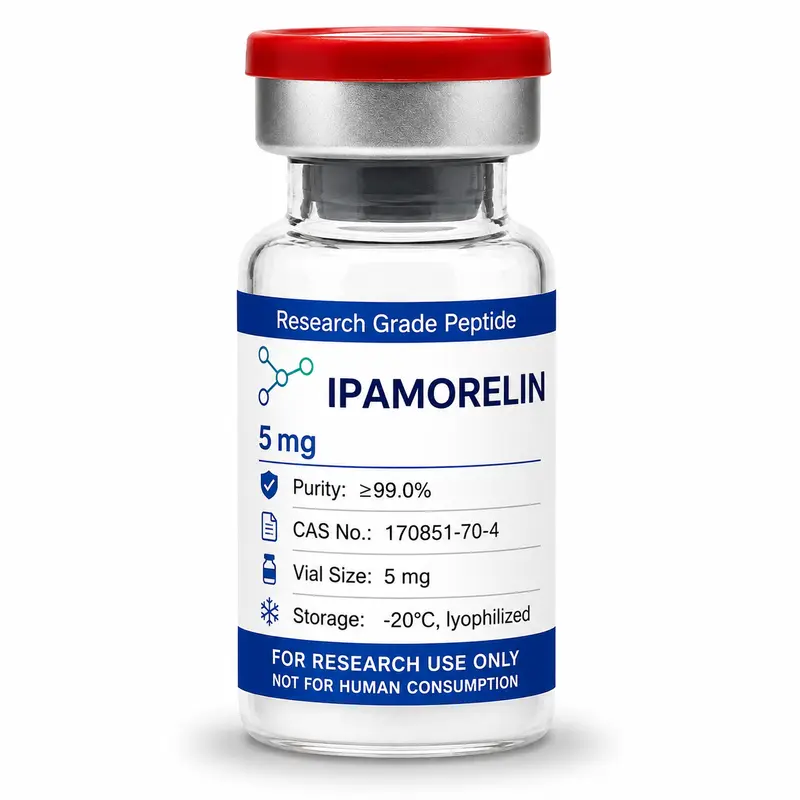
Ipamorelin is a pentapeptide — just five amino acids — engineered to act selectively at the ghrelin receptor with comparatively minimal activity elsewhere. That selectivity is the entire reason it's cited so often in comparative receptor-binding literature: it lets researchers study ghrelin-receptor-specific effects without the confounding activity seen with less-selective compounds.
How it's used in stacked research protocols
Because Ipamorelin's mechanism (ghrelin receptor) is distinct from GHRH-analog mechanisms like CJC-1295, researchers frequently study the two in combination to examine whether activating both pathways together produces a different pulsatile hormone-release pattern than either compound alone.
Sourcing notes
Ipamorelin's small size makes it relatively easy to verify by mass spectrometry — there's no good reason a supplier shouldn't provide sequence confirmation alongside purity data.
Further reading
- Search current Ipamorelin literature on PubMed — peer-reviewed studies indexed by the National Library of Medicine.
- View the Ipamorelin compound record on PubChem — chemical structure and reference data from NCBI.
- Look up CAS 170851-70-4 on CAS Common Chemistry — registry verification from the American Chemical Society.