Semaglutide as a Research Compound: GLP-1 Pathway Basics
What GLP-1 does, briefly
GLP-1 (glucagon-like peptide-1) is a naturally occurring incretin hormone involved in glucose regulation and satiety signaling. It's produced in the gut and has a very short natural half-life — it's broken down within minutes — which limits how useful the native hormone is as a standalone research or clinical tool.
How Semaglutide is different
Semaglutide is a modified analog engineered specifically to resist that rapid breakdown, giving it a dramatically longer half-life than native GLP-1 while still engaging the same receptor. That engineering is what makes it useful as a research tool: it allows for sustained receptor activation in study designs where native GLP-1 would simply degrade too quickly to be practical.
What it's used for in research
Beyond its well-known clinical development history, Semaglutide is a frequent reference compound in receptor-binding kinetics studies, downstream signaling-cascade research, and comparative pharmacokinetic work against other incretin-mimetic peptides. It's often used as a benchmark when researchers are characterizing newer GLP-1 analogs against an established one.
A note on sourcing
Semaglutide is one of the most heavily counterfeited research peptides on the market right now, given its profile. A real certificate of analysis — independent HPLC purity data tied to the specific lot — matters more here than almost anywhere else in the catalog.
Further reading
- Search current Semaglutide literature on PubMed — peer-reviewed studies indexed by the National Library of Medicine.
- View the Semaglutide compound record on PubChem — chemical structure and reference data from NCBI.
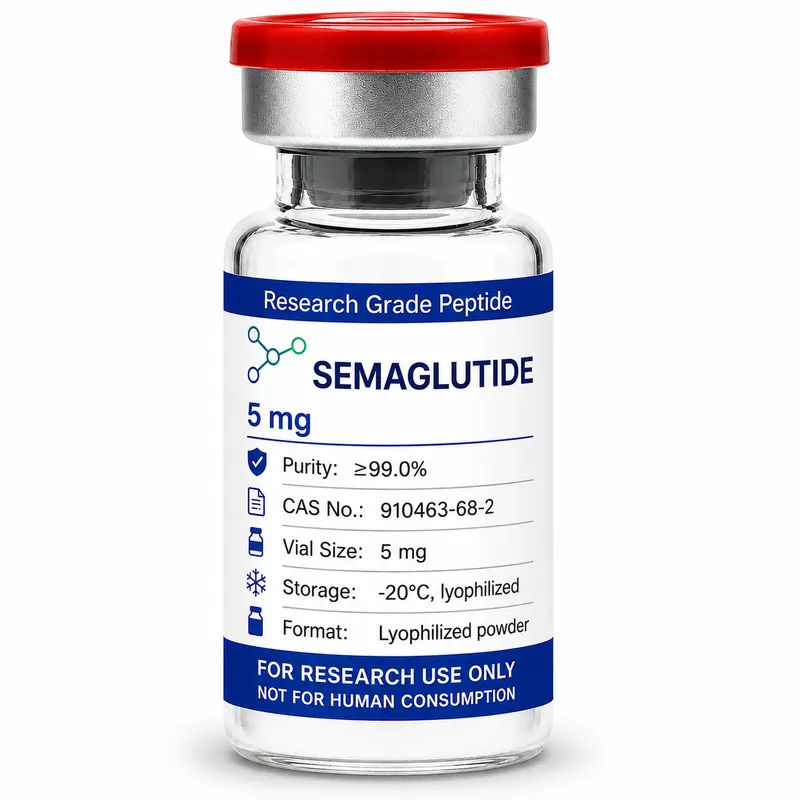
- Look up CAS 910463-68-2 on CAS Common Chemistry — registry verification from the American Chemical Society.