
Selank: A Tuftsin Analog's Role in Cognitive and Stress Research
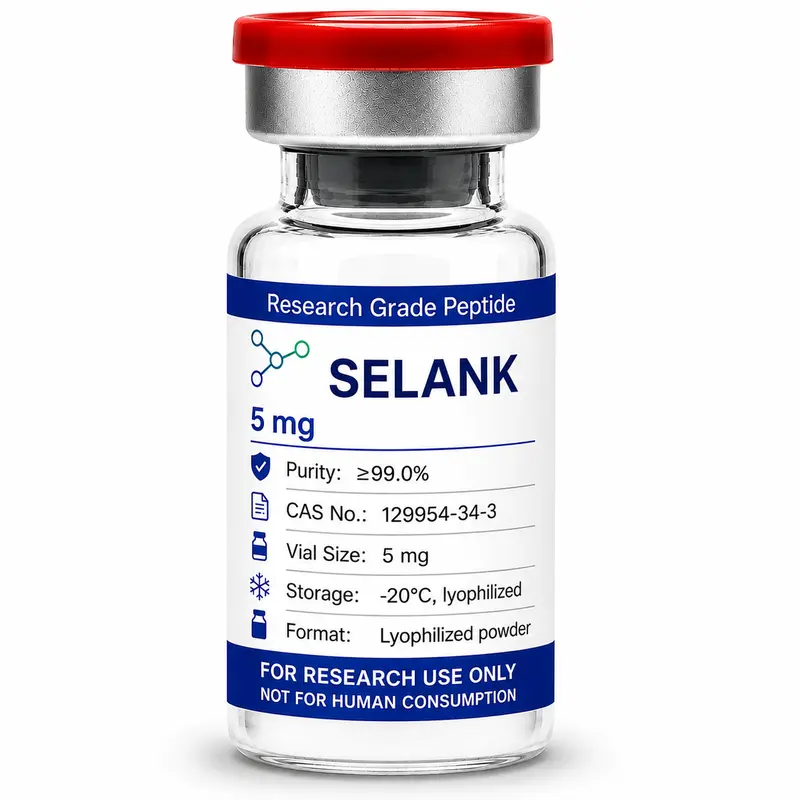
Starting point: tuftsin
Tuftsin is a naturally occurring immunomodulatory peptide fragment, originally identified as part of the IgG antibody heavy chain. Selank was developed as a synthetic analog of tuftsin, with structural modifications intended to improve its stability relative to the native fragment.
What changed structurally, and why it matters
Native tuftsin is broken down quickly once outside a controlled environment, limiting its practicality as a standalone research tool. Selank's modifications are aimed at improving that stability without eliminating the receptor-relevant structure researchers are trying to study — a common design pattern across many synthetic peptide analogs.
Where it's studied
Selank is most frequently referenced in anxiolytic and cognitive-performance research models, where it's used as a comparison point for examining stress-response pathway activity and its structural relationship back to native tuftsin.
Sourcing notes
As with other short synthetic analogs, mass-spec sequence confirmation is straightforward to obtain — a certificate of analysis without it is an easy thing to ask a supplier to fix.
Further reading
- Search current Selank literature on PubMed — peer-reviewed studies indexed by the National Library of Medicine.
- View the Selank compound record on PubChem — chemical structure and reference data from NCBI.
- Look up CAS 129954-34-3 on CAS Common Chemistry — registry verification from the American Chemical Society.