GHK-Cu: The Copper Peptide Behind Decades of Dermal Research
A naturally occurring starting point
Unlike many research peptides that are purely synthetic constructs, GHK-Cu was first identified as a naturally occurring compound in human plasma. Its defining structural feature is a strong affinity for binding copper ions, which turns out to be central to its studied biological activity.
Why copper-binding matters
Copper is a required cofactor for several enzymes involved in collagen cross-linking and extracellular-matrix remodeling. GHK-Cu's ability to chelate and deliver copper in a bioavailable form is why it's become a reference compound in fibroblast-behavior and tissue-remodeling research specifically.
Where it shows up in the literature
GHK-Cu is one of the more extensively published research peptides, with decades of accumulated in vitro and animal-model literature on copper-dependent enzymatic activity and its downstream effects on cell behavior — giving researchers unusually deep comparative data to work from relative to newer synthetic peptides.
Storage matters more here
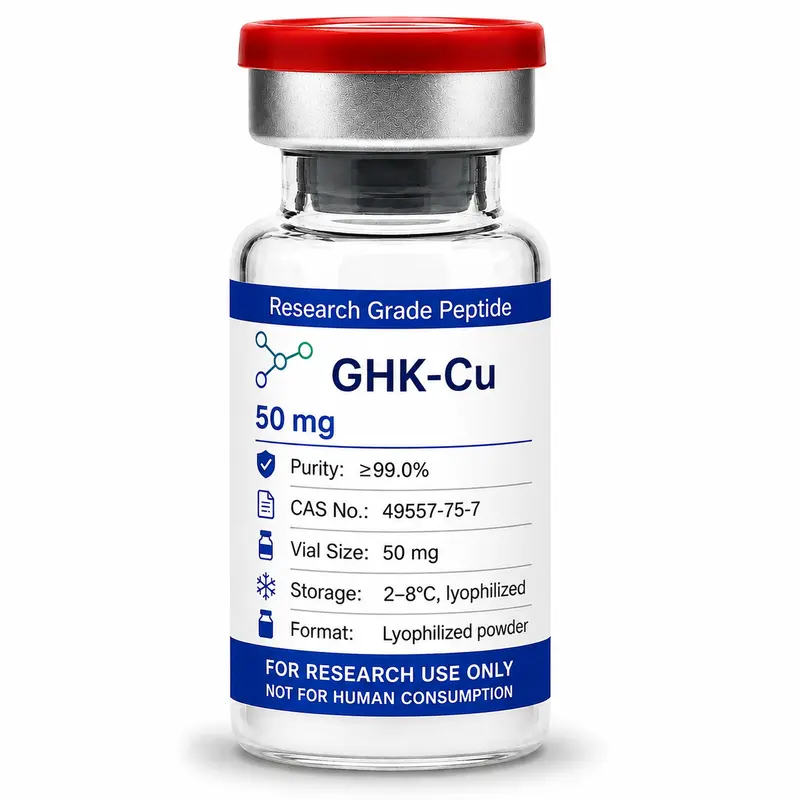
GHK-Cu is typically shipped refrigerated (2–8°C) rather than frozen, unlike most of the peptides in this catalog — worth double-checking with any supplier, since incorrect storage guidance is a common way purity degrades before it even reaches your bench.
Further reading
- Search current GHK-Cu literature on PubMed — peer-reviewed studies indexed by the National Library of Medicine.
- View the GHK-Cu compound record on PubChem — chemical structure and reference data from NCBI.
- Look up CAS 49557-75-7 on CAS Common Chemistry — registry verification from the American Chemical Society.